What are the differences between beach and indoor volleyball rules
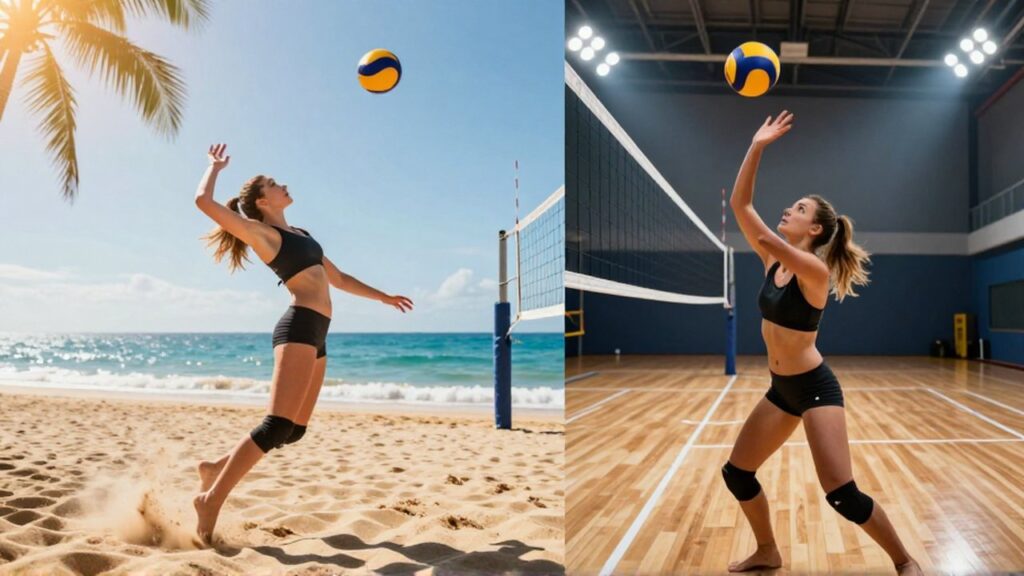
Introduction
Volleyball is a versatile sport that manifests in two distinct forms: indoor and beach. While both versions share the fundamental objective of sending the ball over a net and grounding it in the opponent's court, they are governed by different sets of regulations that significantly alter the pace, strategy, and physical demands of the game. Understanding these differences is essential for players looking to transition between surfaces or for fans wanting to follow professional competitions accurately.
Distinguishing between these two disciplines involves analyzing several key variables, including player counts, court dimensions, scoring systems, and specific technical restrictions. Because the environment—hard court versus sand—dictates how the ball moves and how athletes jump, the rules have evolved to suit the specific challenges of each setting. Recognizing these nuances allows for a deeper appreciation of the tactical complexity inherent in both versions of the sport.
Player numbers and team composition

One of the most immediate differences between the two disciplines is the number of athletes on the court. Indoor volleyball is a team-oriented sport typically played by six players per side. This allows for highly specialized roles, such as setters, liberos, middle blockers, and outside hitters, who occupy specific zones to maximize defensive and offensive efficiency.
In contrast, beach volleyball is defined by its minimalism, almost always played in pairs (two players per side). Without the luxury of six players to cover the court, beach players must be versatile "all-rounders," capable of serving, setting, attacking, and defending equally well. While there are rare variations of beach volleyball with more players, the professional and standard competitive format remains strictly two-on-two.
Court dimensions and environment
The physical space where the game is played changes the geometry of the match. An indoor volleyball court is larger, typically measuring 18 by 9 meters, and is played on a hard, flat surface like wood or synthetic material. This surface allows for explosive movements, rapid lateral shifts, and high-speed defensive maneuvers.
Beach volleyball is played on a much smaller court, measuring 16 by 8 meters. The playing surface is sand, which introduces a layer of instability that affects every movement. The smaller court area is necessary because the sand makes it much harder to cover distance quickly, and the two-player setup would make a full-sized court nearly impossible to defend effectively.
Scoring systems and match duration

While both versions of the sport use "rally scoring"—where a point is awarded on every single serve regardless of who served—the structure of the match differs. Indoor volleyball matches are typically played in a "best of five" sets format. Each set is played to 25 points, and a fifth deciding set is played to 15. A team must win by at least two points in every set.
Beach volleyball matches are usually shorter, often played in a "best of three" sets format. The first two sets are played to 21 points, and if a third tie-breaking set is required, it is played to 15. Similar to the indoor game, a margin of at least two points is required to win a set, but the lower point thresholds in beach volleyball reflect the high intensity and physical exhaustion caused by playing in sand.
Technical rules and ball handling
The rules regarding how a player interacts with the ball vary significantly, particularly regarding the "block" and the "set."
| Feature | Indoor Volleyball | Beach Volleyball |
|---|---|---|
| Block Counting | A block does not count as one of the three team hits. | A block counts as the first of the three permitted hits. |
| Setting Precision | Slightly more leniency on "double hits" during complex plays. | Much stricter rules on "held balls" and double contacts. |
| Ball Type | Heavier and faster-moving to handle indoor air pressure. | Slightly larger, softer, and slower to account for wind. |
| Specialized Roles | Includes the Libero (defensive specialist). | No specialized roles; all players must perform all tasks. |
In indoor volleyball, if a player blocks a ball at the net, the team still has three hits remaining to return the ball. In beach volleyball, the moment a player touches the ball during a block, that contact is counted as the first of the team's three allowed touches. This makes defensive positioning in beach volleyball much more critical, as a blocked ball immediately puts the team in a "two-hit" situation.
Common questions about volleyball variations
Can a beach volleyball player use a libero? No, the libero is a specialized defensive position exclusive to indoor volleyball. In beach volleyball, all players must be able to transition between offense and defense.
Is the net height the same for both versions? No, the net is set at different heights. The indoor net is higher to accommodate the taller stature and vertical reach of six-player teams, whereas the beach net is slightly lower.
How does wind affect beach volleyball rules? Wind is considered a natural part of the game in beach volleyball and is not treated as an interference. Players must adapt their serving and setting techniques to account for the environmental conditions.
Does the ball move differently in beach volleyball? Yes, beach volleyballs are generally slightly larger and have lower internal pressure than indoor balls. This makes them move more slowly through the air, which is necessary when playing in outdoor environments where wind can easily carry a lighter, faster ball.
Leave a Reply